Showing posts with label politics. Show all posts

Tuesday, January 29, 2013

Immigration, economic numbers and the politics of culture

I usually don't write about US politics on this blog but sometimes it helps illustrate some interesting points about the role of science in public life.
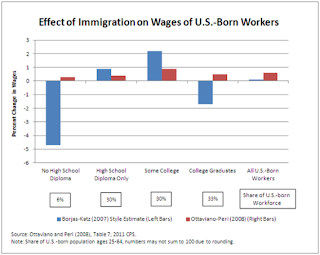

Immigration reform is now on the agenda of the US Congress.  In response, Matt Yglesias (using a chart that illutrates the results of two econometric analyses, see above) writes today that:

Unfortunately, immigration scolds seem to be excessively afraid to voice their real concerns about this, which makes it difficult to address them with either evidence or policy concessions. Instead, we're stuck in a mostly phony argument about wages that does nothing to ease people's real fears about nationalism and identity.
A set of interesting claims is being put forward here, and if I understand it right, a rather strange use of Marx's ideas about the base and superstructure.  For Marx, the base was economic relations and the relationship of the different groups of people to the means of production.  The superstructure was culture; this was seen as deriving from the economic structure, and often served to reproduce this base (through what Marx called false consciousness and ideology). Implicit in Yglesias' assertion is that the effect of immigration on wages uncovered by econometricians corresponds in some sense to what a certain set of Americans feels.  A cumulatively economic effect of immigration on wages that can be uncovered only through the efforts of econometricians is seen as an objective measure (in Theodore Porter's sense) that maps onto the subjective states of people who oppose immigration.  Unfortunately, the econometricians find low or negligible effect, therefore people who oppose immigration must be lying: their reasons are cultural--about nationalism and identity--rather than economic.  We would have a better, more honest discussion, he suggests, if this sham of economic impact (expressed through numbers) was let go of and concentrated on the cultural fears. 

Something similar happened a few days ago but in a different context.  Blogger wunderkind Ross Douthat wrote an op-ed in the Times arguing that that the United States had low fertility rates, which he argued was a problem that the Government needed to think about and perhaps mitigate using policy measures (primarily by creating a "more secure economic foundation" for working-class Americans).  He concluded--omniously--by saying that policy measures could only be effective to a point; low fertility rates were a symptom of "decadence":
The retreat from child rearing is, at some level, a symptom of late-modern exhaustion — a decadence that first arose in the West but now haunts rich societies around the globe. It’s a spirit that privileges the present over the future, chooses stagnation over innovation, prefers what already exists over what might be. It embraces the comforts and pleasures of modernity, while shrugging off the basic sacrifices that built our civilization in the first place.

Such decadence need not be permanent, but neither can it be undone by political willpower alone. It can only be reversed by the slow accumulation of individual choices, which is how all social and cultural recoveries are ultimately made.
To which Matt responded, (calling this last paragraph "nutty")
It'd be a much better country if social conservatives would stop writing things like that second paragraph and focus instead on what's in the first paragraph.
 There was some predictable back-and-forth (see also this).  But his point was clear: it was far better to talk about policy levers--about which a debate can be had--than about notions of "decadence" about which debates are never possible, particularly if you don't subscribe to such notions.

All of which makes me thing that Porter is right on this.  Numbers are indeed "technologies of trust."  At least in the American context, they allow arguments about public life to be made; they make possible arguments that are about objective "facts" rather than subjective "values."  Not that arguments about facts are guaranteed to be settled, but arguments can indeed be made.  Whereas arguments over whether the late modern age is "decadent" or not, between people with incommensurate values, are guaranteed to go nowhere.

Which brings me back to the original post I began this discussion with where Yglesias suggests that it is better to have a national American conversation about the cultural anxieties of immigration (I suspect it would turn out to be equally "nutty").  Kevin Drum responds: 
Cultural insecurity and language angst are the key issues here. It doesn't matter if they're rational or not. Anything we can do to relieve those anxieties helps the cause of comprehensive immigration reform.
A public conversation to relieve cultural anxieties--would it have to take the form of numbers?  What other forms could it take--and where would it lead? 

Friday, January 6, 2012

Social Construction as Conservatism

The release of Corey Robin's book "The Reactionary Mind" and some of the high-profile unfavorable reviews it elicited has led to a backlash in the blogosphere

Mark Lilla's dismissal of the book is on first principles.  He argues that the core principle that unites all the different strains of self-identified conservatives -- and therefore the key difference between liberals and conservatives -- is not, pace Robin, their stance on the progress of the underprivileged, but rather, their stance on human nature.  For conservatives, says Lilla, society comes before individuals: it shapes human nature and constitutes individuals.  Therefore conservatives are loath to tinker with tradition: a slow change in traditions is preferable to the vast upheaval of revolution.  Liberals, on the other hand, do not hold tradition in the high esteem that conservatives do.  They are therefore far more eager to dismantle social structures if they think these structures are impeding human freedom and potential.  For liberals, Lilla argues, individuals come first, society, a distant second.

This is not new, of course and this is a great illustration of what separates, say, Edmund Burke from John Stuart Mill.  But then, after positing this as the main principle distinguishing conservatives from liberals, Lilla goes on to say:
Americans’ assumptions about human nature are basically liberal today. We take it for granted that we are born free, that we constitute society, it doesn’t constitute us, and that together we legitimately govern ourselves. Most intellectuals who call themselves conservatives today accept as self-evident the truths enumerated in the Declaration of Independence, which no traditional European conservative could. Some of them have drawn from European conservatism when they write about the constructive role of civil society, the habits and mores needed to exercise liberty, and the limits of government action. But strictly speaking, they are go-slow, curb-your-enthusiasm liberals like Tocqueville, not conservatives like Burke or T.S. Eliot or Michael Oakeshott. As for those like Congressman Ron Paul who promote a minimal state and an unregulated economy, their libertarianism is actually a mutation of early liberalism, not conservatism. This is important to bear in mind.
All right then!  After positing that it is their stance on human nature that divides liberals from conservatives, it turns out that this distinction is moot in the contemporary American context because, well, everyone is a liberal: they all believe that individuals come before society.  What separates them, then?  Well, it seems to me that it's their stance on the welfare state.  Self-identified conservatives (from the early Public Interest neo-conservatives to the Tea Party) take a far more skeptical stance on the possibility of the welfare state to do good; whereas self-identified liberals are more optimistic about this.  (Note that we've now talking about the American context.) 

But there's another point here.  The ability of the welfare state to do "good," it turns out, is in a specific context: of providing government services to the underprivileged (poor blacks, foreclosed homeowners, and so on).  The difference between liberals and conservatives is thus over two points: (a) the possibility that a some kind of systemic injustice exists.  Liberals will admit to this, and possibly some conservatives will too.  (b) The possibility of doing something about this systemic injustice: It is here that the key difference between conservatives and liberals comes through.  With some oversimplification, one might say that liberals typically agree that if the injustice is bad enough then some steps (i.e. government actions) need to be taken to mitigate it, even if they impede human freedom (within limits).  Conservatives might think that the so-called injustice is not an injustice at all and even if it is, the costs of mitigating it are far more than the expected benefits.  This skepticism may range from Ron Paul-style complaints that, say, forcing Jim Crow-supporting restaurant owners to admit black people into their restaurants is an insupportable infringement of basic liberty to a cautiously Oakshottian stance that since changing social mores rarely works out the way we want it to, strict government regulation might lead to results that we may not quite like, and that therefore policies to remove, say, racial discrimination need to be a little less heavy-handed.

It turns out then that Corey Robin is right after all: the dispute between liberals and conservatives is indeed about the existence of system-wide injustices and over the means to mitigate them.  The question of whether human nature is contingent or fixed, or whether society is ontologically prior to individuals, becomes relevant only in the context of debates over the existence of systemic injustices.  Conservatives are indeed counter-revolutionaries, in the sense that they see no need (or are afraid of) agressive action to remove systemic injustices.  This might be out of the genuine fear that agressive action can have unexpected consequences (which comes out of an ontological belief that society is prior to individuals) or the idea that the systemic injustice in question isn't an injustice at all, but merely a matter of just desserts (which is an apotheosis of extreme individualism).

Indeed, the problem with Robin's book (which I haven't read!) may be what Matt Yglesias points out: it is too mean to conservatives.  And as Sheri Berman points out in her insightful review: it cannot account for fascists who were indeed revolutionaries, not traditionalists.  Far more importantly, it does not account for why conservative ideologies have such populist appeal, even to the very people whose "interests" it is supposedly against (at least, not without using false consciousness as an explanation, which, as Berman points out dryly, is "always a bad sign.").  

Indeed, this brings me back to the reason why I began writing this post.  As Lilla remarks, Americans are all liberals today, in terms of their stance on human nature.  Indeed, the only people who may be truly conservative in the Burkean sense are academics, who are often disparaged as part of the "academic left."  My own discipline of STS (Science and Technology Studies) is explicit about its assumptions: that a great deal of work has gone into constituting human nature as we think about it today, even if that work is not really obvious.  This is often called "social construction": the idea that the institutions that consitute society (say, gender, the family, merit and so on) did not arise spontaneously , in and of themselves, but that they are what they are as a result of a great deal of work (anonymous and overt) and particular historical circumstances. 

This is in itself a conservative argument: that "tradition" is prior to individuals.  Yet, the conclusion it takes is the opposite: if one can show that the deepest traditions are made, it is also possible to change them, and indeed they do change with time.  Most social constructionists will agree with conservatives: that changing our deepest traditions requires hard work, with the ever-present possibility that this work will yield unexpected consequences.  Yet social constructionists are not conservatives (and nor are they considered to be) primarily because they agree that the institutions of society often contain systemic injustices and that work that addresses these inequities is necessary and urgent (even if not easy). 

Monday, February 21, 2011

Neo-conservatism

(Consider this to be me playing the devil's advocate and trying to be provocative) First Tunisia, then Egypt, now Libya, and Bahrain (and god knows what else!) -- does all this mean that the neoconservatives were right after all?

Sunday, February 20, 2011

Nepotism, social capital and elites

Here's Gail Collins (via Crooked Timber):
In Wisconsin, the new Republican governor, Scott Walker, wants to strip state employees of their collective-bargaining rights because: “We’re broke. We’ve been broke in this state for years.” Wisconsin’s Democratic state senators went into hiding to deprive the Republican majority of the quorum they need to pass Walker’s agenda. The Senate majority leader, Scott Fitzgerald — who happens to be the brother of the Assembly speaker, Jeff Fitzgerald — believes the governor is absolutely right about the need for draconian measures to cut spending in this crisis. So he’s been sending state troopers out to look for the missing Democrats. The troopers are under the direction of the new chief of the state patrol, Stephen Fitzgerald. He is the 68-year-old father of Jeff and Scott and was appointed to the $105,678 post this month by Governor Walker. Perhaps the speaker’s/majority leader’s father was a super choice, and the fact that he was suddenly at liberty after having recently lost an election for county sheriff was simply a coincidence that allowed the governor to recruit the best possible person for the job. You’d still think that if things are so dire in Wisconsin, the Fitzgerald clan would want to set a better austerity example.
This is interesting but I think it's a mistake to think about it as something essentially Republican.  This is rather a characteristic of American politics and elite American society in general where social capital plays a big role in the formation of the ruling elite class (business people, politicians, journalists).   My guess is that it starts very early from college itself -- in fact the composition of elite colleges (Harvard, Princeton, Yale) is a key ingredient.  Elite colleges are a great place to make "networks" and it is these networks that we see reflected in the larger political process.  While I wouldn't call it nepotism, it is indeed a sophisticated form of nepotism.  Business-people, politicians -- they all come from the same colleges and attend the same cocktail parties, they own shares in the same companies or share the same stock-brokers.  It's rare to find something as extreme as the case of the Fitzgerald family but my guess is that this kind of "elite culture" is pretty common in the corridors of power. 

[It is also common, for instance, in elite schools in academia, where a kind of consensus on what an elite school is and the resulting social network formation -- the professors were graduate students at elite schools, are friends with other professors in elite schools, conferences are held just between elite schools -- means that elite schools have a very typical constitution in terms of its student and faculty-body and tend to self-perpetuate.]

Thursday, December 9, 2010

Tax cuts for the rich

I mostly don't write about politics (for a lot of reasons, but mostly because most people have already said it better!) but this paragraph in David Leonhardt's "Economic Scene" column struck me as interesting:
Mr. Obama effectively traded tax cuts for the affluent, which Republicans were demanding, for a second stimulus bill that seemed improbable a few weeks ago. Mr. Obama yielded to Republicans on extending the high-end Bush tax cuts and on cutting the estate tax below its scheduled level. In exchange, Republicans agreed to extend unemployment benefits, cut payroll taxes and business taxes, and extend a grab bag of tax credits for college tuition and other items.
Now consider this: Leonhardt is a reporter for the Times.  As such, when he writes an op-ed type piece, it is mostly in the restrained way that the "Analysis" sections for the paper are written (see here, for example).   He doesn't -- and I would think, can't -- write in the way the Times op-ed writers write.  (For instance, see Paul Krugman's latest, which has a decidedly -- and probably justifiably -- apocalyptic tone.)

And yet, just read that opening paragraph I quoted above.  Even a simple, diplomatic, faux-objective rendering of the recent tax-cuts deal makes it very clear: what the Republicans wanted was for richer people (or to be more technical, those making more than 250,000 a year.  And the estate tax cut will only benefit multi-millionaires.).  How on earth will the Republicans spin this?  One would think that the Democrats can make hay with this with some good old-fashioned rabble-rousing against-the-fat-cats type of populism.  But no.  Listen to this missive from Kevin Drum, about how the deal is spun in Virginia:
I hate to say this but I do have my ear to the ground with a lot of "regular" folks and the way this impending "deal" is being described by most of them is that Republicans are pushing to keep the tax cuts which create jobs and the Democrats are pushing to extend unemployment benefits so lazy people can sit on their asses a while longer and live off those of us who work hard.
In other words, it is not Republicans who will end up being defensive about the deal but Democrats!  Even when the concessions that the Democrats fought for will benefit more people -- and more importantly, people in need -- as well as give the economy a much-needed stimulus.  Here is a graphic that shows the number of people who will benefit because of the concessions the Democrats fought for (link):


I have no stake in this battle, really.  But it strikes me that something interesting is going on here.  Republican voters in the US routinely list the deficit as their main concern.  Making the Bush tax cuts permanent, the Republicans' main priority, will increase the deficit anyway.  (And to be fair, Democrats are fine with making the tax cuts that apply to family incomes less than 250k permanent as well).  So how does the perception that the tax cuts are good even if they increase the much-cared for deficit come about?

One theory could be the Marxist notion of "false consciousness," that voters are in the grip of an ideology (in the Marxist sense).  I find these explanations unsatisfying. 

My guess is that the deficit -- a technocratic concept if there was one -- has fused into the notions of responsibility that constitute these voters' identities.  So these voters tolerate higher deficits if it is for "responsible" reasons but not so much if the deficit expands in response to an extension of unemployment benefits (even if they see unemployment all around them). I think this is an issue where some qualitative research -- in the form of extensive, unstructured interviews with Republican voters -- might help.  How has the deficit seeped into their very selves?  How do they understand themselves in terms of this deficit?  Anyone know of any research on this? 

-------------------------
Postscript: I began to think of George Lakoff's may be on to something after all -- even if Lakoff's theory is too much like the false consciousness in the guise of cognitive science.  Lakoff says voters typically think of the state in terms of the family metaphor: the nation-as-family metaphor.  A state with a deficit therefore corresponds to a family living beyond its means, a classic sign of irresponsibility.  That explains the deficit but what about support for the tax cuts?  Anyone know of any other possible explanations?  Any theories of political identity-formation that can be applied here?

Friday, April 23, 2010

Can we ever read articles of the opposite political persuasion? An alternative model

ResearchBlogging.org
Sean A. Munson, & Paul Resnick (2010). Presenting diverse political opinions: how and how much Proceedings of the 28th international conference on Human factors in computing systems : http://doi.acm.org/10.1145/1753326.1753543


Can we ever be convinced by someone we usually disagree with completely? Can we even manage to read regularly people whose views are antithetical to our own? These are fascinating questions, I think. First, because they are political questions; conversations and debates matter very much for any kind of open, democratic society. But I find them fascinating because they also bring up questions about the nature of knowledge: is knowledge just a matter of true and false propositions? Or is it something different, a mangle of practices, propositions and institutions, and in some way inherently inarticulable?

I bring all this up because of a talk I attended at CHI 2010 -- a presentation of a paper by Sean Munson and Paul Resnick at the University of Michigan -- that explored their very preliminary results of getting people to read articles with opposite political persuasions. Here's the abstract:
Is a polarized society inevitable, where people choose to be exposed to only political news and commentary that reinforces their existing viewpoints? We examine the relationship between the numbers of supporting and challenging items in a collection of political opinion items and readers' satisfaction, and then evaluate whether simple presentation techniques such as highlighting agreeable items or showing them first can increase satisfaction when fewer agreeable items are present. We find individual differences: some people are diversity-seeking while others are challenge-averse. For challenge-averse readers, highlighting appears to make satisfaction with sets of mostly agreeable items more extreme, but does not increase satisfaction overall, and sorting agreeable content first appears to decrease satisfaction rather than increasing it. These findings have important implications for builders of websites that aggregate content reflecting different positions. [pdf]
Remember this was a CHI paper so there was a lot of emphasis on how to "present" diverse views so as to make people read them. The results were disappointing -- people don't really seem to want to read the opposite side -- but since not everything has been tried yet, and the web still has a lot to evolve, we shouldn't really lose hope.

I want to speculate on a different sort of model in this blog-post. I am going to take for granted that people of opposite political persuasions need to talk to each other in a liberal democracy*. But if it is important for Democratic-leaning and Republican-leaning (or as they are called in the US, liberal and conservative) voters to talk to each other, is it a good way to rank news articles and people on a sliding scale from liberal to conservative and then mix and match them up? Or do we need to classify people (and articles) on some other orthogonal parameter? I.e. a parameter that doesn't correlate with being Democratic or Republican-leaning.

In what follows, I am going to propose two such parameters. This is by no means a very systematic analysis, just some thoughts that I've been playing around with, based on my own personal experiences. Most important, I have absolutely no idea how I would go about implementing such a system computationally and frankly, it may be wrong and not even work in practice. With all those caveats in mind, here goes.

The first parameter maps the content of an article. The content of an article spans the spectrum from "uncertain" to "certain". An "uncertain" article sounds unsure of itself, has many caveats in it, has a respectful tone perhaps, even if it does have definite conclusions. A "certain" article is more sure of itself, perhaps more dogmatic, even snarky. One point though. If an article is uncertain, does that mean that its author is non-ideological? Not at all. All it means is that he chooses to express himself in a certain way that seems uncertain even though the article itself may end up endorsing a very specific ideological point.

The second parameter maps the disposition of the reader. The disposition of the reader spans from "prefers interesting" to "prefers true". This is not a straight-forward spectrum and its terms need some explanation.

The terms are based on the expression "I prefer saying something interesting to something true". E.g. most philosophers**, you see, would rather write something interesting and therefore be read by generations, than solve a problem definitively and thus not be discussed at all in a few decades. In the same vein, a reader who prefers something interesting likes intricate arguments even if sometimes they lead to conclusions he does not agree with. Note that this does NOT mean that this sort of reader does not have an ideology or that he is an "independent." Nothing of the sort is required, just that he likes to read clever things.

Since no ideology has a monopoly on clever things to say so this reader probably reads a lot of clever things that come out of his own camp. A reader who prefers "true" things is the opposite. He prefers "truth" to "play", has no use for "play" and would rather prefer to say it as it is. When I say truth, I don't really mean truth-as-it-exists. I mean things that the reader believes to be true. Note that most readers will fall somewhere in between these two positions.

If indeed, in an ideal world, these metrics i.e. the certainty of an article, and the disposition of the reader could be computed with some degree of accuracy, and if we also knew the ideology of the reader as well as the ideology of the article, this is what I would do in order to get people to read articles with opposite points of view:
The flowchart is clearly a little vague and is not meant to represent some definite algorithm. The heuristic that it depends on is that those readers with a taste for the interesting will find at least some of the uncertain articles that are however in the opposite ideological camp thought-provoking to read.

At this point, it also seems appropriate to explain the theory of knowledge that underwrites this model:
  • I assume that a person's ideology gets fixed pretty early in life. A person has an ideology by the time he or she reaches the mid-twenties. Ideology however does not mean a voting preference. It means a way of looking at the world, a preference for certain types of people (who become your friends) and a certain set of issues that become important, and a certain stance towards them.
  • Ideologies do not change because someone offers "rational" arguments for the opposite side. People only change their minds about certain things, and these things are small technical things. World-views do not change much. When they do, and this is rare, the comparable analogy for it is religious conversion.
This seems pretty bizarre at first sight. After all, if one believes that world-views don't change, why even bother recommending articles of the opposite ideology? The mistake here, I think, is that people assume that getting people to read more articles of the opposite ideology is just an instrument for something else, sometimes termed "bipartisianship." I think of it as an end on its own, irrespective of whether it makes people change their views (which I don't think it does anyhow).

Let me make one final point before I end this (pretty unsatisfactory) post. What makes me think that people don't change their minds all that much? Well, for one, it's my own interactions with people. Arguments about politics or policies are rarely closed, the way that arguments about the validity of a mathematical proof are, for instance. So there is no control on what counts as an argument. People usually have an infinite variety of arguments to choose from and many discussions are a circle of question-begging assertions.

In his book, Knowledge and Social Imagery, David Bloor provides a very good example of how world-views are woven together. In tribal Azande society, an oracle is usually asked to tell the people the witches residing in their midst. Being a witch is taken to be a hard physical fact and it is commonly believed that a male witch passes on this "substance" to his sons, a female witch to her daughters. One would therefore think that when the oracle says someone is a witch, the whole corresponding line of people will have been or will be witches. In practice, however, the Azande don't act this way, only the close paternal kinsmen of a known witch are considered witches.

At this point, one could simply say that the Azande are being illogical and irrational. But to counter this, Bloor gives another example, one that's closer to our own culture. We commonly believe that a murderer is one who deliberately kills people. But in that case, are pilots and soldiers also murderers? As citizens who rely on the armed forces to protect us, we will immediately resist this conclusion. But aren't we being illogical or irrational here? After all, if one takes the laws of logic seriously, they lead us inexorably to this conclusion: All murderers kill people deliberately. Soldiers kill people deliberately. So all soldiers are murderers.

But no, someone will say. It all depends on what you mean by "deliberately." Soldiers don't kill "deliberately," they kill to protect us, or they kill because one of us had been killed. Or it all depends on what you mean by "kill." And so on and on. The point here is that our ideologies are "informal knowledge", we believe them because they are common cultural practices. When we reason about them ("formal knowledge"), the laws of logic and reasoning are flexible enough that we can use them to justify what we only know informally (i.e. our ideologies). That's why rational argument never succeeded in converting someone to a different ideology. Arguments like that tend to go round and round in circles. But that doesn't mean that they are unimportant or that one shouldn't be having them. One should just remember what they can or can't accomplish.

*The discussion above is heavily US-centric. In India, for example, it is very hard to isolate "opposite" political persuasions, but that's a topic for another day.

** E.g. here is Daniel Dennett's variant of it:

In an informal survey, I have been asking philosophers a slightly different question recently, and will be pleased to field further answers in response to this review: Which would you choose, if Mephistopheles offered you the following options?

(1) simply solving an outstanding philosophical problem so definitively that after a few years, only historians ever mentioned it (or your work) again, or

(2) writing a book that was so tantalizingly equivocal and problematic that it would be required reading for philosophy students for centuries to come.

The history of science offers many instances of the first sort, and none, really, of the second, but I find that many of my philosophical colleagues admit to being at least torn by the choice. They would rather be read than right. Perhaps it is of the "essence" of philosophical problems to admit of no permanent solutions, though I doubt it, but in either case it is no wonder we make so little progress.