Tuesday, August 31, 2010

Scott Rosenberg vs. Nicholas Carr

Scott Rosenberg has a nice post up on his blog explaining why the studies that Nicholas Carr cites to show that web links impede understanding do nothing of the sort.  This doesn't completely rebut what Carr is saying, of course, but it does tell us that it's really too soon to know whether links impede or enhance our understanding.

Here's the relevant graf:
“Hypertext” is the term invented by Ted Nelson in 1965 to describe text that, unlike traditional linear writing, spreads out in a network of nodes and links. Nelson’s idea hearkened back to Vannevar Bush’s celebrated “As We May Think,” paralleled Douglas Engelbart’s pioneering work on networked knowledge systems, and looked forward to today’s Web.
This original conception of hypertext fathered two lines of descent. One adopted hypertext as a practical tool for organizing and cross-associating information; the other embraced it as an experimental art form, which might transform the essentially linear nature of our reading into a branching game, puzzle or poem, in which the reader collaborates with the author. The pragmatists use links to try to enhance comprehension or add context, to say “here’s where I got this” or “here’s where you can learn more”; the hypertext artists deploy them as part of a larger experiment in expanding (or blowing up) the structure of traditional narrative.
These are fundamentally different endeavors. The pragmatic linkers have thrived in the Web era; the literary linkers have so far largely failed to reach anyone outside the academy. The Web has given us a hypertext world in which links providing useful pointers outnumber links with artistic intent a million to one. If we are going to study the impact of hypertext on our brains and our culture, surely we should look at the reality of the Web, not the dream of the hypertext artists and theorists.
The other big problem with Carr’s case against links lies in that ever-suspect phrase, “studies show.” Any time you hear those words your brain-alarm should sound: What studies? By whom? What do they show? What were they actually studying? How’d they design the study? Who paid for it?
To my surprise, as far as I can tell, not one of the many other writers who weighed in on delinkification earlier this year took the time to do so. I did, and here’s what I found.

You recall Carr’s statement that “people who read hypertext comprehend and learn less, studies show, than those who read the same material in printed form.” Yet the studies he cites show nothing of the sort. Carr’s critique of links employs a bait-and-switch dodge: He sets out to persuade us that Web links — practical, informational links — are brain-sucking attention scourges robbing us of the clarity of print. But he does so by citing a bunch of studies that actually examined the other kind of link, the “hypertext will change how we read” kind. Also, the studies almost completely exclude print.
If you’re still with me, come a little deeper into these linky weeds. In The Shallows, here is how Carr describes the study that is the linchpin of his argument:
In a 2001 study, two Canadian scholars asked seventy people to read “The Demon Lover,” a short story by the modernist writer Elizabeth Bowen. One group read the story in a traditional linear-text format; a second group read a version with links, as you’d find on a Web page. The hypertext readers took longer to read the story ,yet in subsequent interviews they also reported more confusion and uncertainty about what they had read. Three-quarters of them said that they had difficulty following the text, while only one in ten of the linear-text readers reported such problems. One hypertext reader complained, “The story was very jumpy…”
Sounds reasonable. Then you look at the study, and realize how misleadingly Carr has summarized it — and how little it actually proves.
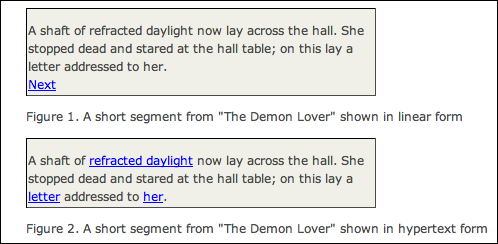
The researchers Carr cites divided a group of readers into two groups. Both were provided with the text of Bowen’s story split into paragraph-sized chunks on a computer screen. (There’s no paper, no print, anywhere.) For the first group, each chunk concluded with a single link reading “next” that took them to the next paragraph. For the other group, the researchers took each of Bowen’s paragraphs and embedded three different links in each section — which seemed to branch in some meaningful way but actually all led the reader on to the same next paragraph. (The researchers didn’t provide readers with a “back” button, so they had no opportunity to explore the hypertext space — or discover that their links all pointed to the same destination.)
Here’s an illustration from the study:


Bowen’s story was written as reasonably traditional linear fiction, so the idea of rewriting it as literary hypertext is dubious to begin with. But that’s not what the researchers did. They didn’t turn the story into a genuine literary hypertext fiction, a maze of story chunks that demands you assemble your own meaning. Nor did they transform it into something resembling a piece of contemporary Web writing, with an occasional link thrown in to provide context or offer depth.
No, what the researchers did was to muck up a perfectly good story with meaningless links. Of course the readers of this version had a rougher time than the control group, who got to read a much more sensibly organized version. All this study proved was something we already knew: that badly executed hypertext can indeed ruin the process of reading. So, of course, can badly executed narrative structure, or grammar, or punctuation.
Rosenberg also has a nice follow-up post on what it is that links actually end up doing in articles on the web.  

Friday, August 6, 2010

A brief comment about Inception (*no spoilers*)

Just saw Inception today.  I liked it a lot but it's an almost textbook illustration of Christopher Nolan's strengths and weaknesses as a director.  As is my nature, I will dwell more on the weaknesses, but then I think everyone appreciates the strengths already (the movie's success testifies to that!).  So, without any further ado:

Nolan is -- to use the film's own language -- an architect, but not an artist.  He's a master at creating concepts, fleshing them out.  His films resemble jigsaw puzzles more than anything else, an intricate array of pieces that come together in the end, where the glue that holds the audience is the connection between the pieces even if the pieces themselves are pretty uninteresting.

Nolan is TERRIBLE at action sequences.  TERRIBLE.  How-do-the-studio-bosses-let-him-get-away-with-it-terrible.  That's the biggest problem in Inception: none of the big fight sequences makes any sense whatsoever.  By that I mean, there is no sense of time and space, just random cutting between people shooting at each other.  Terrible.  However, Inception has a far more intricate structure than The Dark Knight, so audiences don't really notice.  Still, its incoherent action sequences (and the fact that there are so many of them!) makes Inception just about a  so-so movie (as opposed to being a really good one).

Nolan's expository sequences are clunky but his big emotional scenes just don't work.  The man clearly needs a good script-writer to make his concepts work.

More points about the movie in general:

Hans Zimmer's score is way over-the-top, distracting and unnecessary.  Sometimes I could barely hear what the actors were saying.

The performances are smart but Marion Cotillard's goes into pure awesomeness territory!  I have stopped being surprised at how good Joseph Gordon-Levitt is in any role.  Oh, and someone needs to give Ken Watanabe a lesson in diction.

Wednesday, July 28, 2010

What's good for me is good for you

Yes, what's good for the publishing industry is also good for us. How could we be so stupid and not know this?
Many would argue that the efflorescence of new publishing that Amazon has encouraged can only be a good thing, that it enriches cultural diversity and expands choice. But that picture is not so clear: a number of studies have shown that when people are offered a narrower range of options, their selections are likely to be more diverse than if they are presented with a number of choices so vast as to be overwhelming. In this situation people often respond by retreating into the security of what they already know.

[...]

At the Book Expo in New York City, Jonathan Galassi, head of Farrar, Straus and Giroux, spoke for many in the business when he said there is something "radically wrong" with the way market determinations have caused the value of books to plummet. He's right: a healthy publishing industry would ensure that skilled authors are recompensed fairly for their work, that selection by trusted and well-resourced editors reduces endless variety to meaningful choice and that ideas and artistry are as important as algorithms and price points in deciding what is sold.
I always love how a "we are under attack and need to survive" argument is never made, instead the argument becomes -- without any self-consciousness whatsoever -- "we are under attack and our demise will result in the decline of civilization and therefore bad for EVERYONE."

Friday, July 23, 2010

Algorithmic culture and the bias of algorithms

Via Alan Jacobs, I came across a thought-provoking blog-post by Ted Striphas on "algorithmic culture."  The issue is the algorithm behind Amazon's "Popular Highlights" feature.  (In short, Amazon collects all the passages in its Kindle books that have been marked, collates this information and displays it on its website and/or on the Kindle.  So you can now see what other people have found interesting in a book and compare it with what you found interesting.)

Striphas brings up two problems, one minor, one major.  The minor one:
When Amazon uploads your passages and begins aggregating them with those of other readers, this sense of context is lost. What this means is that algorithmic culture, in its obsession with metrics and quantification, exists at least one level of abstraction beyond the acts of reading that first produced the data.
This is true but it could easily be remedied.  Kindle readers can also annotate passages in the text and if they feel like it, they could upload their annotations along with the passages they have marked.  That should supply the context of why the passages were highlighted. (Of course, this would bring up another thorny question: what algorithm to use to aggregate these annotations.) 

But he brings up another far more important point:
What I do fear, though, is the black box of algorithmic culture. We have virtually no idea of how Amazon’s Popular Highlights algorithm works, let alone who made it. All that information is proprietary, and given Amazon’s penchant for secrecy, the company is unlikely to open up about it anytime soon.
This is a very good point and it brings up what I often call the "bias" of algorithms.  Algorithms, after all, are made by people and they show all the biases that their designers put into them.  In fact, it's wrong to call them "biases" since these actually make the algorithm work!  Consider Google's search engine.  You type in a query and Google claims to return the links that you will find most "relevant."  But "relevant" here means something different from the way you use it in  your day-to-day life.  "Relevant" here means "relevant in the context of Google's algorithm" (a.k.a. PageRank). 

The problem is that this distinction is lost on people who just don't use Google all that much.  I spend a lot of time programming and Google is indispensable to me when I run into bugs.  So it is fair to say that I am something of an "expert" when it comes to using Google.  I understand that to use Google optimally, I need to use the right keywords, often the right combination of keywords along with the various operators that Google provides.  I am able to do this because:
  1. I am in the computer science business, and I have some idea of how the PageRank algorithm works (although I suspect not all that much) and 
  2. because I use Google a lot in my day-to-day life.  

I suspect that (1) isn't at all important but (2) is.  

But (2) also has a silver lining.  In his post, Striphas comments:
In the old paradigm of culture — you might call it “elite culture,” although I find the term “elite” to be so overused these days as to be almost meaningless — a small group of well-trained, trusted authorities determined not only what was worth reading, but also what within a given reading selection were the most important aspects to focus on. The basic principle is similar with algorithmic culture, which is also concerned with sorting, classifying, and hierarchizing cultural artifacts. [...] 

In the old cultural paradigm, you could question authorities about their reasons for selecting particular cultural artifacts as worthy, while dismissing or neglecting others. Not so with algorithmic culture, which wraps abstraction inside of secrecy and sells it back to you as, “the people have spoken.”
Well, yes and no.  There's a big difference between the black box of algorithms and the black box of elite preferences. Algorithms may be opaque but they are still rule-based.  You can still figure out how to use Google to your own advantage by playing with it.  For any query you give to it, Google will give the exact same response (well, for a certain period of time at least).    So you can play with it and find out what works for you and what doesn't.  The longer you play with it, the longer you use it, the more you become familiar with its features, the less opaque it seems.

Not so with what Striphas calls "elite culture," which, if anything, is far more opaque and far less amenable to this kind of trial-and-error practice.  (That's because the actions of experts aren't really rule-based.)

I am not sure where I am going with this and I am certainly not sure whether Amazon's Kindle aggregation mechanism will become as transparent as Google's search algorithm by trial-and-error but my point is that it's too soon to give up on algorithmic culture.


Postscript: My deeper worry is that when we actually reach the point when algorithms are used far more than they are now, the world will be divided into two types of people.  Those who can exploit the biases of the algorithm to make it work well for them (like I do PageRank).  And those who can't.  It's a scary thought although since I have no clue about how such a world will look like, this is still an empty worry.

Monday, July 19, 2010

The problem with the problem with behavioral economics

There's a lot to like in George Loewenstein and Peter Ubel's op-ed in the New York Times on the limits of behavioral economics and it's possible to draw various conclusions from it.  But the piece is at heart just a good old-fashioned moral criticism of government (and the Democratic Party)  for not doing the "right" thing and indirectly, also of democratic politics in general.


Loewenstein and Ubel’s op-ed is mostly aimed at warning people that behavioral solutions are no panacea. I am only a modest consumer of this research so I cannot evaluate all their claims. Yet, it strikes me that if they are right, their argument is really quite damning for the behavioral economics revolution. Essentially, they assert that traditional economic analysis has ultimately much more relevance for the analysis of major social problems and for finding solutions to them. Behavioral economics can complement this but cannot be a viable alternative. Within political science and other social sciences the insights of behavioral economics are sometimes interpreted as undermining the very foundations of classical economic analysis and warranting an entirely different approach to social problems. At the very least, the op-ed is a useful reminder that careful scrutiny of effect sizes matters greatly. 
I suspect this is right.  But this has far more to do with the disciplinary matrix of economics than it has to do with the insights of the behavioral revolution.  I am no economist but as I understand it, the idea that  human beings use a certain form of cost-benefit analysis to make economic decisions (homo economicus) forms the cornerstone of traditional economics.  According to this theory, people make decisions that maximize benefits and minimize costs.  But this, of course,  all depends on what counts as a cost and what counts as a benefit, about which the homo economicus model says nothing.

Initially at least, costs and benefits were thought to be monetary.  Increasingly, we are beginning to realize that we need to factor in culture into these costs and benefits.  And while behavioral economics has helped us understand that there are costs and benefits that are not monetary in nature, it has not changed the cost-benefit model itself.  In that respect, it has in no way undermined the foundations of economic theory.

As an amazon.com reviewer puts it (scroll down to read):
At root, the rational actor model says "people act to maximize utility." Utility is left more or less undefined.
Thus, the model really says "people act to maximize something." Or put differently, "There exists a way to interpret human behavior as a maximization of something."  Although it does not look like it, this is a statement about our ability to simulate a human using an algorithm. It is on par with the statement that humans are Turing machines.
This model will never lose, because it is very flexible. A challenge to the model will always take the form of a systematic or nonsystematic deviation between some specific "rational actor" model and the true actions of a human. But the challenge will always fail:
- A systematic deviation will by definition always be combatted by enriching the rational actor model to eliminate the deviation.
- A nonsystematic deviation is explainable as "noise" or "something we don't understand yet."

[...] There is really no way to beat the rational actor model, because it is really the outline of a research program, it is not a fleshed-out model. And the research program is the correct one, by the way.
Being a Kuhnian, I wouldn't say that this research program is the "correct" one.  But it's an extraordinarily productive one, that gives its practitioners the ability  to construct a variety of problems and solve them.  In that respect behavioral economics cannot be -- and never was -- an alternative to it.

Wednesday, June 30, 2010

Do we save versions on Word?

Ruth Franklin, in a recent short essay in The New Republic -- in turn a reaction to Sam Tanenhaus' essay on John Updike's archives -- makes this strange remark:
But the computer discourages the keeping of archives, at least in their traditional form. If Updike had been working in Word, he might have left no trace of the numerous emendations to the opening airport scene of Rabbit at Rest, which Tanenhaus carefully chronicles.
What on earth is she talking about? Is this how essayists write in Word? With one single file that is endlessly written in again and again until the final draft is ready? Because that's not how my papers get written, at any rate. Each paper that I have submitted to any conference is composed in a series of drafts -- sometimes up to 25 drafts -- all of which are numbered. And I don't think I am alone in this.

My guess is that writing stories on the computer will end up giving us far more drafts than writing on paper ever could.

So -- again -- what on earth is she talking about?

Wednesday, June 9, 2010

Richard Rorty and idea of research

[This post is a little different from others; it summarizes my engagement with the works of the philosopher Richard Rorty.  I like Rorty's work a lot but interestingly enough, I find that he helps me less as "research" and more as a guide to understand how to live a good life (on which, more to come some other time).  This post argues that Rorty was subtly dismissive of research itself (and his reasons for doing so!) and this, in turn, is why systematic thinkers don't care for him all that much.  Why Simon Blackburn, for instance, calls him the "professor of complacency" or why Thomas Nagel doesn't even deign to mention him in The View from Nowhere.]

When I started reading Richard Rorty's magnum opus "Philosophy and the Mirror of Nature," the first thing that surprised me was that Rorty's heroes -- according to him, the three greatest philosophers of the twentieth century: Heidegger, Wittgenstein and Dewey -- were hardly to be found in the book.  The book was instead focused almost completely on analytic philosophers: Quine, Sellars, Davidson and Kuhn, among others.  Most of Mirror of Nature is occupied with understanding how the notion of the mind (and knowledge) as the "mirror of nature" came to be so widely established, as well as how recent developments have shown that this notion is mistaken.  Instead, Rorty argues:   
[...] "objective truth" is no more and no less than the best idea we currently have about how to explain what is going on.  [...] inquiry is made possible by the adoption of practices of justification and [...] such practices have possible alternatives.  They [i.e. these practices] are just the facts about what a given society, or profession, or other group, takes to be good ground for assertions of a certain sort.  Such disciplinary matrices are studied by the usual empirical-cum-hermeneutic methods of "cultural anthropology."  [Page 385]
Consider what Rorty is saying here.  The discipline of philosophy has long conceived itself to be an arbiter of knowledge claims.  Now typically, all disciplines (psychology, history, geology, physics etc.) make knowledge claims so the job of philosophy (once the physical world had been ceded for explanation to the natural sciences) was to adjudicate between these claims, to put upstart disciplines (say, like sociology or cultural anthropology) in their places and to proclaim the superiority of, say, physics as an ideal for all other disciplines to look up to.  But behind this, says Rorty, is the presumption that the mind is a mirror of nature and truth means a correspondence between words and things.  Recent developments in analytic philosophy itself -- the work of Quine, Sellars, Davidson, Kuhn -- have led to a breakdown in this idea.  Truth is far better described in terms of the practices of justification used by communities of practitioners to "prove" something is true rather than in terms of correspondence, the key question being how communities of human beings (quantum physicists, mathematicians, etc.) with their own methods and cultures decide to agree upon certain things (what counts as evidence, what counts as good evidence and so on).

Now these are just the sorts of things that are studied by the sciences of society: sociology and cultural anthropology* (and to a much smaller extent, psychology).  This would make cultural anthropology the arbiter of knowledge claims, no?  Taking over the status of philosophy and all that?

Well, no, not really.  The most irritating thing in Mirror of Nature is the cavalier way Rorty treats his beloved "practices of justification" -- the same ones that he thinks are the key to understanding knowledge and epistemology.   Not as a topic of research, not as an area where we are far from having the last word, but as a solved problem, something to be dismissed as just cultural anthropology.  Whereas it's far from clear that we have actually figured out just what those practices of justification work. 

However, as I read more, I realized what Rorty was trying to do.  To remove the pretensions of philosophers (and philosophy) that they stand at the top of the great-chain-of-disciplines is one thing.  But it would be counter-productive to do this and then simply replace philosophy with another discipline as THE discipline that adjudicates knowledge claims.  So Rorty, preferring to remain true to his non-hierarchical conception of the disciplines, studiously plays down cultural anthropology.  Fair enough.

But sometimes, he seems to go further than that, actually disparaging the very idea of research.  As an example, consider this sentence:
To say that we have changed ourselves by internalizing a new self-description [...] is true enough.  But this is no more startling than the fact that men changed the data of botany by hybridization, which was in turn made possible by botanical theory, or that they changed their own lives by inventing bombs and vaccines.  [Page 386]

The passage seems to be doing two things at once.  First, it makes a cognitive claim: that, as a topic of investigation, changing one's life by internalizing a self-description should be given no more importance than, say, the change in human life caused by the invention of vaccines.  Fair enough.  But it also seems to imply that the problem of how human beings internalize a particular self-description is already solved.  But is it really?  No!  So why would Rorty try and hint something like that?  [In my copy of Mirror, I have scrawled "But how???" next to this paragraph.]

The key to what Rorty is trying to do lies in a section called "Systematic Philosophy and Edifying Philosophy" (page 365).   Here, he points out that there are two types of philosophers.  There are systematic philosophers whose aim is to do research; meaning that they are interested in systematically investigating certain issues (say epistemology). Systematic philosophers can be revolutionary, meaning that they can change completely the vocabulary of the field itself.  But even these philosophers are committed to a vision of philosophy as research and would presumably like their own vocabularies to be institutionalized.  In contrast to these, there are edifying philosophers (or thinkers) who do not attempt to be systematic, are not interested in research per se.  Even if they offer some revolutionary thoughts (like, say, the later Wittgenstein), they dread having their own vocabularies institutionalized; they most emphatically do not want to initiate a new research tradition.

One way to see edifying philosophy as the love of wisdom is to see it as the attempt to prevent conversation from degenerating into inquiry, into a research program.  Edifying philosophers can never end philosophy, but they can help prevent it from attaining the secure path of a science.

(Even I -- as someone generally sympathetic to Rorty's cause -- was riled when I read the line above about conversation degenerating into inquiry.)  

You can see this extension being extended to all types of thinkers in general, not just philosophers.  By thinkers I mean physicists, biologists, cultural anthropologists, historians, novelists, poets, actors, directors; anyone who expresses herself in a certain way though a certain medium.

The distinction between systematic and edifying thinkers then turns out to be this: systematic thinkers like to understand the world but they aren't very interested in changing it.  Or rather, while they may be interested in changing it, they are far more interested in the abstractions that come out of their research.  Which is not to say that their research cannot have uses -- nor that it can't change the world -- but just that they aren't interested in it for that reason.  Also they are read by only a limited set of people i.e. other specialists.  Physicists, chemists, molecular biologists, philosophers, psychologists, sociologists, cultural anthropologists, mathematicians -- every one of us who likes systematic research -- all fall into this category.

As opposed to this, there are edifying thinkers.  They too have abstract interests but their work has the capacity to change the world simply because their work is accessible to more people.  Novelists, poets, ethnographers, journalists, social workers and above all, politicians, fall into this category.   At their best, they broaden the horizons of the human experience, they make us understand and empathize with others, those with whom we couldn't possibly have had any contact otherwise.  Edifying thinkers -- along with edifying technologies: the novel, the television program, the play -- are responsible for improving human solidarity and making today's liberal democratic societies possible.

Richard Rorty wants you to be an edifying thinker, not a systematic one.  Philosophy and the Mirror of Nature can be looked at as an exhortation to pursue a career where there is more of a possibility to change the world -- if not in an earth-shaking way, then, at least, in a much smaller way.  The most astounding thing is that, despite being a book about epistemology, it succeeds.  E.g. Matthew Yglesias admits that Mirror "convinced me that fascinating as I find the problems of philosophy to be, it made more sense to spend my time trying to apply the skills I learned thinking about them to the problems of the world than to the problems themselves."  I would argue that this is exactly the kind of response that Rorty would have wished for. Certainly Yglesias influences far more people now, writing about politics and public policy as a blogger, than he would have otherwise, even if he had tried to become a Rortyan "edifying philospher."

In his review of Mirror, Ian Hacking argues that Rorty's arguments from Quine, Sellars and Davidson can be taken as against a certain kind of epistemology, one that models knowledge as a static unchanging representations of things that are "out there," but another kind of epistemology is certainly possible that is more holistic and looks at knowledge as a a historical phenomenon that is made possible by (or "constructed") certain changes in the constitution of societies.  Indeed, Hacking and Foucault can be considered to be practitioners of this new epistemology.

I don't think Rorty would disagree with that.  But he doesn't want us to be doing epistemology, period -- even if it is historical ontology.  He wants us to do things that change the world tangibly and becoming practitioners of the new epistemology would do nothing to change the world; as it is a science that is more interested in looking back and then even further back.  Hacking's "history of the present," Rorty would argue, doesn't really change the present, except in that it initiates new research programs, all of which, in turn, keep looking backwards!

It is sort of this subtle hostility (but no outright antagonism) to research that Rorty exhibits -- and its all-too-apparent success in weaning off promising researchers e.g. Yglesias -- that I think is the reason why researchy philosophers (Nagel, Searle, et al) are in turn so hostile to Rorty.  It's also the main reason that as an epistemologist, I find Rorty to be not-so-useful.  Because Rorty doesn't want to promote any research agenda and has a (deliberate) tendency to treat interesting problems (of practices of justification, inter-subjectivity, etc.) as solved or not-so-interesting, his synthesis of Sellars, Quine, Davidson et al is only useful to a point.  Once you read him, you can go to all the sources that he points -- Hacking, Davidson, Sellars, Kuhn, Foucault, Heidegger, Dewey -- who agree with Rorty about the Mirror of Nature but unlike him, are also committed to understanding knowledge. 

[Rorty, however, is a wonderful philosopher of life, a point that I may address sometime in another post.]  
---------------------------------------------------------------------
Endnotes:
* E.g. on page 381 Rorty says:
I want to claim, on the contrary, that there is no point in trying to find a general synoptic way of "analyzing" the "functions knowledge has in universal contexts of practical life," and cultural anthropology (in a large sense which includes intellectual history) is all we need.