Showing posts with label Reading. Show all posts

Tuesday, August 31, 2010

Scott Rosenberg vs. Nicholas Carr

Scott Rosenberg has a nice post up on his blog explaining why the studies that Nicholas Carr cites to show that web links impede understanding do nothing of the sort.  This doesn't completely rebut what Carr is saying, of course, but it does tell us that it's really too soon to know whether links impede or enhance our understanding.

Here's the relevant graf:
“Hypertext” is the term invented by Ted Nelson in 1965 to describe text that, unlike traditional linear writing, spreads out in a network of nodes and links. Nelson’s idea hearkened back to Vannevar Bush’s celebrated “As We May Think,” paralleled Douglas Engelbart’s pioneering work on networked knowledge systems, and looked forward to today’s Web.
This original conception of hypertext fathered two lines of descent. One adopted hypertext as a practical tool for organizing and cross-associating information; the other embraced it as an experimental art form, which might transform the essentially linear nature of our reading into a branching game, puzzle or poem, in which the reader collaborates with the author. The pragmatists use links to try to enhance comprehension or add context, to say “here’s where I got this” or “here’s where you can learn more”; the hypertext artists deploy them as part of a larger experiment in expanding (or blowing up) the structure of traditional narrative.
These are fundamentally different endeavors. The pragmatic linkers have thrived in the Web era; the literary linkers have so far largely failed to reach anyone outside the academy. The Web has given us a hypertext world in which links providing useful pointers outnumber links with artistic intent a million to one. If we are going to study the impact of hypertext on our brains and our culture, surely we should look at the reality of the Web, not the dream of the hypertext artists and theorists.
The other big problem with Carr’s case against links lies in that ever-suspect phrase, “studies show.” Any time you hear those words your brain-alarm should sound: What studies? By whom? What do they show? What were they actually studying? How’d they design the study? Who paid for it?
To my surprise, as far as I can tell, not one of the many other writers who weighed in on delinkification earlier this year took the time to do so. I did, and here’s what I found.

You recall Carr’s statement that “people who read hypertext comprehend and learn less, studies show, than those who read the same material in printed form.” Yet the studies he cites show nothing of the sort. Carr’s critique of links employs a bait-and-switch dodge: He sets out to persuade us that Web links — practical, informational links — are brain-sucking attention scourges robbing us of the clarity of print. But he does so by citing a bunch of studies that actually examined the other kind of link, the “hypertext will change how we read” kind. Also, the studies almost completely exclude print.
If you’re still with me, come a little deeper into these linky weeds. In The Shallows, here is how Carr describes the study that is the linchpin of his argument:
In a 2001 study, two Canadian scholars asked seventy people to read “The Demon Lover,” a short story by the modernist writer Elizabeth Bowen. One group read the story in a traditional linear-text format; a second group read a version with links, as you’d find on a Web page. The hypertext readers took longer to read the story ,yet in subsequent interviews they also reported more confusion and uncertainty about what they had read. Three-quarters of them said that they had difficulty following the text, while only one in ten of the linear-text readers reported such problems. One hypertext reader complained, “The story was very jumpy…”
Sounds reasonable. Then you look at the study, and realize how misleadingly Carr has summarized it — and how little it actually proves.
The researchers Carr cites divided a group of readers into two groups. Both were provided with the text of Bowen’s story split into paragraph-sized chunks on a computer screen. (There’s no paper, no print, anywhere.) For the first group, each chunk concluded with a single link reading “next” that took them to the next paragraph. For the other group, the researchers took each of Bowen’s paragraphs and embedded three different links in each section — which seemed to branch in some meaningful way but actually all led the reader on to the same next paragraph. (The researchers didn’t provide readers with a “back” button, so they had no opportunity to explore the hypertext space — or discover that their links all pointed to the same destination.)
Here’s an illustration from the study:
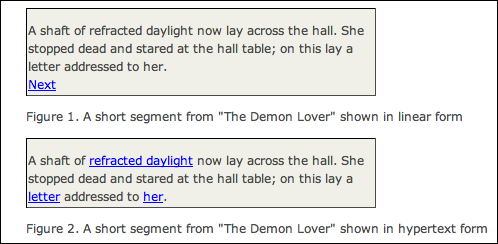

Bowen’s story was written as reasonably traditional linear fiction, so the idea of rewriting it as literary hypertext is dubious to begin with. But that’s not what the researchers did. They didn’t turn the story into a genuine literary hypertext fiction, a maze of story chunks that demands you assemble your own meaning. Nor did they transform it into something resembling a piece of contemporary Web writing, with an occasional link thrown in to provide context or offer depth.
No, what the researchers did was to muck up a perfectly good story with meaningless links. Of course the readers of this version had a rougher time than the control group, who got to read a much more sensibly organized version. All this study proved was something we already knew: that badly executed hypertext can indeed ruin the process of reading. So, of course, can badly executed narrative structure, or grammar, or punctuation.
Rosenberg also has a nice follow-up post on what it is that links actually end up doing in articles on the web.  

Friday, May 28, 2010

How we read (articles and magazines) now

In this post, I want to compare the two modes of reading: how we read before the internet and how we read now. I will be limiting the analysis only to news articles and magazines since I believe, pace Nicholas Carr, that it isn't still clear how the internet has changed book-reading habits. But today, the internet IS the platform for delivering news and I believe it has changed our reading habits substantially. (It's also caused a big disruption in the publishing industry.)

Just to be clear, the analysis in this post is based on a sample size of 1: me! But I believe the salient points will hold true for many others.

How we read Pre-internet


Back in the days when there was no internet, we had two newspapers delivered to our home in the morning: a newspaper in English (we alternated between The Times of India or the Indian Express) and one in Marathi (Maharashtra Times or Loksatta). On Mondays we also took in the Economic Times and on weekends, my father would usually buy some more from the news-stand (The Sunday Observer, The Asian Age).

My father would usually read every newspaper from the first page to the last. My mother would usually only read the Marathi newspaper. My sister and I would usually at least skim through the English newspaper but concentrate on a few sections (usually comics, editorials, and sports).

Even in India, where newspapers are generally smaller, (i.e. less number of pages compared to, say, the tome that is the daily New York Times), a newspaper would try to cover everything it thought needed to be covered. So while the bulk of it would be devoted to national politics, there would be a smattering of world news, book reviews, entertainment and sports news, etc. No issue would be covered in too much depth (because of lack of space, which in turn corresponded to the high cost of newsprint) and the issues covered would be chosen keeping in mind the broad preference of a newspaper's readers.

So if you were interested European Union politics, you would be lucky to get an article every two weeks. But at the same time, the very fact that newspapers felt that they were the only way we got content, they did feel obligated to at least sample the whole spectrum of topics. E.g. even if the sports pages were dominated by cricket, soccer and tennis, at least once in a while, volleyball and football would be covered.

In the figure above (click to see full figure), I have chosen to represent how we read back then in terms of two orthogonal axes: the breadth of reading (X-axis) and the depth of reading (Y-axis). The breadth of reading corresponds to the topics that we could cover, the depth of reading corresponds to how much we could cover on a certain topic. Each line represents a topic; how long the line is corresponds to how deeply a topic is covered.

The characteristics of pre-internet reading were:
  • The newspaper/magazine decided what topics it would cover (and it tried to take the interests of the majority of its readers into account). This meant, to some extent, that the "long tail" of topics was not covered.
  • The limited space available for a newspaper meant that:
    • The depth that it could go into for any topic that it covered was limited.
    • However topics were sampled uniformly across the spectrum of topics. Which meant that even if you didn't care for national politics at all, the very act of glancing through the newspaper everyday forced you to have some idea of what was going on. Ditto for sports, or for entertainment.
Pre-internet reading thus tended to emphasize breadth over depth. This was its advantage as well as its disadvantage. Diligent readers were "well-rounded" but they came up against the hard limit of newsprint if they wanted to know more.

How we read now

Reading on the internet is different.

There's far far more material to read, and it's easy to get to, requiring nothing more than a click of the mouse.

There's also more control over the material meaning you can decide what you want to read and ignore the stuff that you don't care for. E.g. if you are interested in economic policy you can subscribe to the Business feed of the NYT and nothing else. If you're interested only in foreign policy and particularly in the U.S.-China relationship, you can use Yahoo Pipes and set up filters that will bring to you only those articles that mention the U.S. and China.

Finally, there's more depth. A newspaper, even an online newspaper, can only devote so much time and space to U.S.-China relations. But on the internet, this material can be augmented with the many blogs and wikis out there. There are blogs by anthropologists and economists, by foreign policy and international relations experts, and by political scientists, -- you name it! -- all of whom are interested in conveying their point of view to both lay and specialized audiences. In other words, you can choose to specialize in whatever you want and your specialization will be world-class.

In the figure above (click to see full figure), I've tried to represent the characteristics of online reading in terms of its breadth and depth. The characteristics of internet reading are
  • We get to decide what topics we want to read about.
  • There is unlimited "space;" it is possible to access any conceivable magazine or newspaper; in addition there are blogs, wikis and Twitter feeds that we can use as our filters to get to the interesting stuff that we care for.
    • One can go as deep into a topic as one wants.
    • But since our time is ultimately limited, emphasizing depth has the effect of sacrificing breadth. One could go as deep as one wants and read about international relations but the cost could well be no time to read any sports news. Whether this is a good or bad thing, I am not sure.
Reading on the internet tends to emphasize depth over breadth. This is its advantage as well as its disadvantage. It's possible to indulge your interests a lot, but it comes at the cost of being "well-rounded."

Friday, August 15, 2008

In praise of skimming: A response to Nicholas Carr's "Is Google making us stupid?"

Nicholas Carr's essay in the Atlantic -- provocatively titled "Is Google making us stupid?"-- has, not surprisingly, aroused a lot passionate reactions.

Channeling Maryanne Wolf's Proust and the Squid, Carr makes the reasonable assertion that the way we read shapes the way we think. And increasingly, we do most of our reading on the internet: skipping, skimming and scanning our way through articles and blogposts. He contrasts this style of reading with the kind of deep contemplation that is necessary for reading, say, War and Peace. If reading on the internet discourages "deep" reading, Carr worries, does that mean we are all starting to think differently -- becoming more "transient" and less reflective? Is deep thinking is on the way out? Is Google making us stupid? (I know, I know, this sounds like one of those voiceovers from Sex and the City).

This is an interesting and important question. But Carr's article, at least in the way it is framed, manages to conflate a number of related issues. It's fundamental flaw is the implicit assumption that there is only one (correct) way to read and it involves "strolling through long stretches of prose". It doesn't matter whether we're reading fiction or non-fiction or whether we're reading for work or in our leisure time. The result is an essay whose underlying anxiety manages to resonate but whose point isn't at all clear. I actually agree with Carr. I certainly think that the internet is changing something in the way discourse producers work (and by this term I mean academics, journalists, writers etc who read and write for a living). Notice that this is a much narrower claim -- how they think is another, more nebulous issue and I am not particularly sure that that's going to change.

Consider the disconnect in Carr's first anecdote.
Bruce Friedman, who blogs regularly about the use of computers in medicine, also has described how the Internet has altered his mental habits. “I now have almost totally lost the ability to read and absorb a longish article on the web or in print,” he wrote earlier this year. A pathologist who has long been on the faculty of the University of Michigan Medical School, Friedman elaborated on his comment in a telephone conversation with me. His thinking, he said, has taken on a “staccato” quality, reflecting the way he quickly scans short passages of text from many sources online. “I can’t read War and Peace anymore,” he admitted. “I’ve lost the ability to do that. Even a blog post of more than three or four paragraphs is too much to absorb. I skim it.”
Notice that there are two arguably unrelated things here:
  • (a) Friedman's inability to "read and absorb a longish article on the web or in print": This presumably has to do with his work as a blogger.
  • (b) Friedman's inability to read War and Peace in his leisure time.
Carr clearly seems to be implying that (a) and (b) are related, and that both are caused by the amount of time that Friedman, a blogger, spends on the internet for work.

I suspect that reading War and Peace after a hard day's work is ... difficult, even for those whose work doesn't involve reading tons of things on the internet. Indeed, as Friedman admits here (scroll down for his comment) -- he reads a lot of novels (mainly mysteries and thrillers) for recreation in his leisure time. We can therefore safely eliminate Friedman's high volume of internet reading as the cause of (b).

(a) is much more interesting but Carr has next to nothing to say about it. Now presumably, as a discourse-producer, Friedman has to look at different books, articles, blog-posts, papers and then synthesize/summarize them in blog-posts of his own. But notice that when Friedman says that he cannot read a blog-post of more than 4 paragraphs, he means that he does not read it word for word, instead he skims it. In other words, when something slightly longish presents itself to him, Friedman slips, almost by default, into "skim mode".

Carr clearly despairs at this but my own reaction is: so what? Carr seems to think that all reading takes place in isolation -- that we read for the sake of reading. But while this may be true for our leisure reading, this is almost certainly not true when we read for work. The real issue here is that assuming Friedman skims more now than he did pre-internet, has it affected his output? Is his writing better or worse? Are his arguments sharper, deeper, shallower? Does he write more? Or less? These are all very interesting questions but it doesn't seem to me that Carr is really interested in these. (Of course, these questions might get you published in an academic journal but they certainly wouldn't be cover-story material for The Atlantic Monthly, no?)

So now let me restate Carr's point -- which he may or may not buy. His thesis is that the internet and Google will change the way that these producers of discourse go about their work, that they will skim more than they used to -- and more worrying for Carr, I think -- and they will not think as deeply because deep reading is deep thinking.

I am not convinced about the second part of this at all. First, because discourse producers don't just read aimlessly, they read for a purpose (an article, an essay, a review) and that purpose itself will require rigorous thinking. In the course of their project, they may go through a variety of reading material (blog-posts, journal papers, books). They may skim most of it, deep-read a few. But in the end, they have to synthesize their arguments and marshal facts and sources to back them up -- and to do all this well, deep thinking is essential.

However:
  • The weak part of Carr's thesis is certainly true -- we do skim more. And perhaps reading on the internet may have reduced our "skimming threshold" -- like Friedman who starts skimming if an article is more than 4 paragraphs. But the reason for this is that the internet presents us with ten times the reading material we would otherwise have had.
In my own case, to write this blog-post, I read Carr's original piece in the Atlantic the "traditional" way, word for word. I skimmed through most of the reactions the article generated -- concentrating on the few that seemed most relevant. (Clay Shirky's is the most penetrating, if a bit short. Jaron Lanier's is bizarrely short and off-topic.) I knew the New Yorker had reviewed Proust and the Squid but after looking it up on Google, I ended up skimming four reviews: times.co.uk, Bookforum, The New Yorker and the Guardian. Google also led me Bruce Friedman's comment about his reading habits. And it took me to the study by University College, London, that Carr quotes from.

This is perhaps the key problem that discourse producers face -- what to skim and what to read deeply. And the internet has exacerbated it -- because now everything is available at our fingertips. To be successful today, it not only becomes necessary to skim but it becomes essential to skim well.
  • We may end up writing in shorter bites -- almost certainly a good thing in my opinion.
As Kevin Drum points out, most non-fiction articles are grossly padded. Knowing that there will be a lot of articles users will want to browse, will writers try to be more concise in their arguments? More brief, to the point? I am sure this will not be a completely unwelcome development.

Conclusion? The internet certainly encourages skimming -- but skimming isn't easy! It could certainly mean less deep-reading in the long run but deep thinking will almost certainly remain. Finally the very fact that there is so much to skim will compensate to some extent the fact that we have less time to read something word by word.